In May, Ogawa et al. (2025)1 reported their findings concerning the potential anti-myopic effects of a mountain camp experience. From just 1 week of intense outdoor activity, Japanese schoolchildren showed increase thickness of the layer responsible for retinal blood supply (the choroid) along with decreases in eyeball length and myopic refractive error. This study was built on prior research which found that exposure to violet light (~400 nm) – which is ‘nonexistent indoors’ – is ‘essential to prevent myopia’, acting through a non-visual light receptor in the retina called OPN5.
Other researchers are studying how the interior design of our homes or urban design of residential and educational spaces can affect the prevalence and progression rate of myopia in urban schoolchildren around the world.
In this article series we go through what is being uncovered about the environmental risks of myopia, with graphics to help you manage healthy habits and living choices.
Myopia, also known as short-sightedness, is a condition that develops when the eyeball grows too long, measured as ‘axial elongation’. This change in length affects the eye’s ability to focus far images onto the retina at the back of the eye, so distant objects appear blurry while near visual focus remains clear. You can watch an animation here. The process of axial elongation may begin in adulthood or early childhood, often associated with schooling intensity and urban living. In this article, we will focus on properties of the visual environment associated with childhood-onset myopia.
Prevalence of myopia and high myopia (< -6 Dioptres) has been increasing around the world, with East Asia showing the sharpest rise since the 1980s.2 Populations in East Asia (and Singapore) exhibit earlier ages of onset now, ranging from 4 – 7 years old, which is associated with higher eventual myopia in adulthood.3 The trend is not geographically isolated, with patterns linked to culture and immigrant communities. Myopia prevalence has been rising in Europe, North America, and to a lesser extent Africa and Latin America.4 Therefore, the trend cannot be explained by genetic factors alone. Environmental factors and gene-environment interactions are an important consideration for public health officials and eyecare practitioners hoping to reduce the incidence and consequences of myopia in a population. Since children spend most of their directed time in school and at home, tweaking these spaces in science-informed ways makes sense for mitigating risk.

Data source: Key groups and their proportion of myopia prevalence according to the systematic review and meta-analysis by Liang et al. (2025) in the British Journal of Ophthalmology.
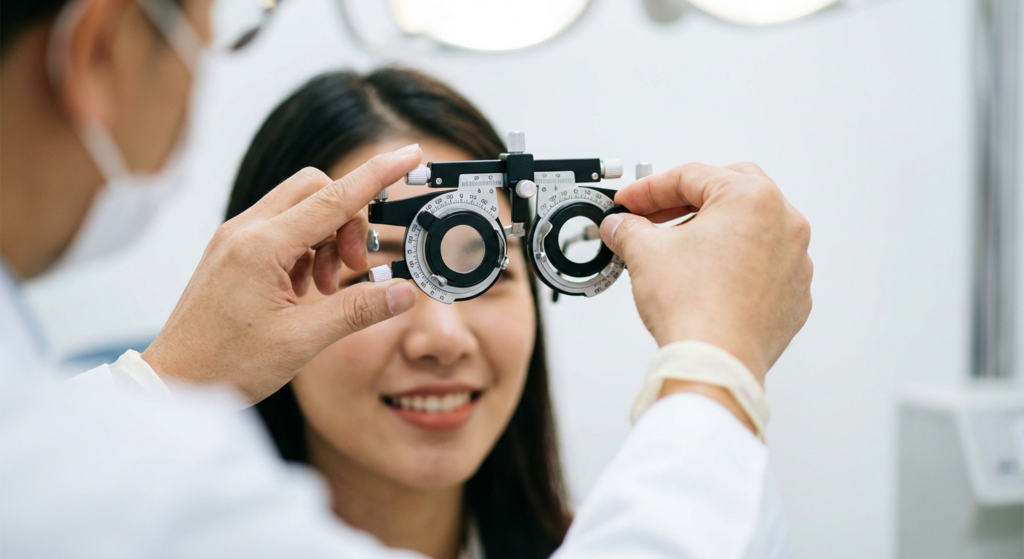
Role of an Optometrist and Myopia Management
Due to an identified need to reduce myopia prevalence and progression, eyecare has evolved from providing only vision correction of refractive errors to myopia management. Beyond providing clear vision by altering refractive power at the front/anterior eye, these approaches aim to slow axial elongation and thus protect the delicate cells and tissue at the back of the eye long-term. In this sense, neither standard lenses nor LASIK surgery as an adult offer holistic correction of myopia, as they only address the anterior surface of the eye.
Most people don’t realise that besides causing short-sightedness, the structural changes to tissues at the back of the eye in moderate/high myopia can increase the risk of several blindness-causing eye diseases past the age of 40. High myopia is even associated with anxiety in later life.5 This is why the healthcare industry and researchers are so concerned. Besides the physiological costs in later life, interventions that slow myopia progression are more expensive than refractive correction. So, it makes sense to reduce the environmental and behavioural sources of risk for myopia onset and progression as much as possible.6
Why is public awareness of environmental risks important for myopia management?
Children and their parents are a crucial part of the myopia management process. Even in research, data-gathering is shifting to focus on fine, individualised details about environmental risks in an effort to equip the public with knowledge about protective habits.
Awareness of age-related vulnerability and ‘myopic’ visual stimuli allow for strategic – but also fun and healthy – decision-making in the home about myopia management. Adherence to eyecare check-ups as well as nurturing good reading and lifestyle habits make a real difference to myopia onset and progression, and therefore long-term ocular health.
Some studies are focused on genetic susceptibility, protective factors, and therapeutics, but there is also a call to improve measurement techniques for quantification and standardisation of more personal, precise analysis of environmental factors.
Many family habits built up to manage myopia in children can be positive for adult health and fitness as well.
For example: Want better quality sleep? Get more natural light from daily outdoor activities. It can help your brain use the spectral cues from sunrise and sunset to maintain circadian rhythm.
Quite remarkably, satellites like Landsat 8 and Gaofen-2 have allowed researchers to better understand how neighbourhood features like urban greenery (Cui et al., 2024; In Barnett-Itzhaki et al., 2024)7 and ‘inter-architectural distance’ linked to skyscraper shadows by Zhang et al. (2024)8 can impact childhood myopia at the district and city level. At the school level, satellite imagery and urban science metrics have been employed by Zeng et al. (2025)9 to show how constricted classroom sizes may be correlated with higher myopia.
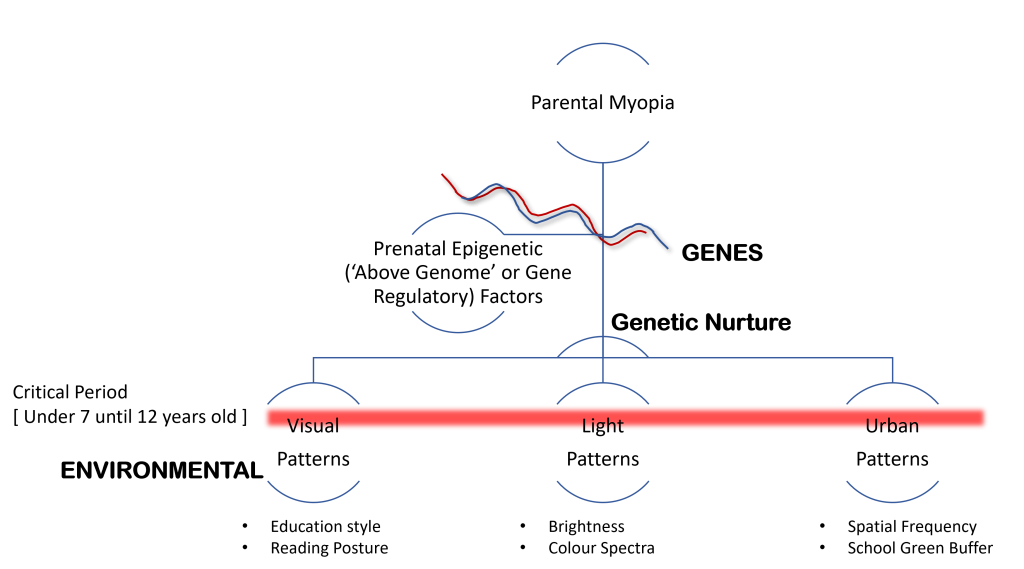
Parental Myopia – Genetic Nurture
Genetics play a role in susceptibility to myopia onset and progression, and so do prenatal epigenetics.10 Interventions also show variability in terms of safety and efficacy across different ethnic groups, demonstrated by the Vanderbilt study on atropine.11 Having two myopic parents still seems to be the strongest determinant for myopia risk in children, and this is regardless of ethnicity.12
However, this influence may not be purely genetic, as parents select elements of the environment for their young children, e.g.:
- Home: Location and interior design
- Their ‘predisposition toward higher education’ (See Lee & Mackey, 2022)13
- Lifestyle as a result of culture, peer group etc.
- Academic style and pressure, for example linked to Confucian values (See Yii, 2024)14
The Committee on Focus on Myopia (2024) cited Guggenheim’s term ‘genetic nurture’ (2017) to refer to this phenomenon in their detailed summary of research on myopia onset and progression, which you can read here.15
In the series that follows, we will try to keep it a bit simpler. Windows are used to categorise environmental sources of myopia risk, and recent research is summarised accordingly.
Watch Your Windows
Myopia’s Environmental Risks and Management
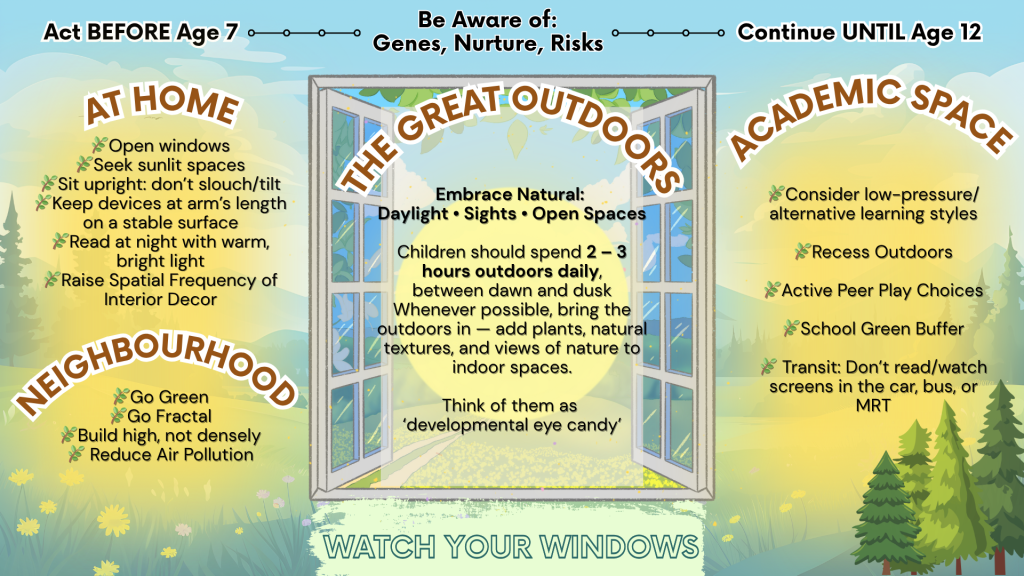
Myopia and the Visual Environment
Research is steadily uncovering the visual elements of the environment that may be affecting myopia development.
This includes children’s visual habits, light properties such as brightness and colour spectra of indoor lighting, and visual properties of the home and wider urban design. For ease of understanding – although in reality they are interrelated – the categories are divided into:
Window 1:
Elements of the Great Outdoors
Window 2:
The Home & Neighbourhood
Window 3:
Academic Space & Styles
Try to think of expanding Window 1, spreading it’s natural, photic (light), and visual influence into 2 and 3 as much as possible.
In East Asia, highly competitive economies and educational systems instead often lead to an expansion of Window 3, meaning children’s eyes are in a sense ‘closed’ to the outdoors and the visual cues it provides to growing eyes.
We are learning that besides simply being outside 2 – 3 hours per day, there are ways to modify living and educational environments to manage myopia, as individuals and with certain public policies.
It is best to keep it simple for a sustainable approach to myopia management. However, the biological reality is extremely complicated in terms of both the ocular system and the properties of the visual environment that it interacts with. The process of factor-untanglement for design of optimal interventions is underway.
Also keep in mind that over-corrections such as sun-gazing or extreme unschooling could yield undesirable consequences. Best to have a chat with your eyecare professional to craft a measured response, and we are happy to answer any questions.
Stay Tuned for Part II: The Window Frame, which goes through what we know about timing. The temporal window of before age 7 until age 12 suggests timing for strategic investment in and interventions for myopia management.
- 1 Ogawa, M., Torii, H., Yotsukura, E. et al. (2025) Intensive outdoor activity for 1 week increases choroidal thickness in Japanese schoolchildren: a prospective observational study. BMC Ophthalmol., 25, 300. https://doi.org/10.1186/s12886-025-04128-2
- 2 Mackey, D. (2020, January 7). Short-sightedness in kids was rising long before they took to the screens. The Conversation. https://medicalxpress.com/news/2020-01-short-sightedness-kids-screens.html
- 3 Dolgin, E. The myopia boom. Nature, 519, 276–278 (2015). https://doi.org/10.1038/519276a; Hu, Y. et al. (2020). Association of Age at Myopia Onset With Risk of High Myopia in Adulthood in a 12-Year Follow-up of a Chinese Cohort. JAMA Ophthalmol., 138(11), pp. 1129–1134. https://jamanetwork.com/journals/jamaophthalmology/fullarticle/2770767
- 4 Liang, J. Pu, Y., Chen, J. et al. (2025). Global prevalence, trend and projection of myopia in children and adolescents from 1990 to 2050: a comprehensive systematic review and meta-analysis. British Journal of Ophthalmology, 109, pp. 362-371. https://bjo.bmj.com/content/109/3/362 Roxby, P. (2024, September 25). One in three children short-sighted, study suggests. BBC. https://www.bbc.com/news/articles/c0m099zm4wyo
- 5 Du, Y., Meng, J., He, W., Qi, J., Lu, Y., & Zhu, X. (2024). Complications of high myopia: An update from clinical manifestations to underlying mechanisms. Advances in ophthalmology practice and research, 4(3), 156–163. https://doi.org/10.1016/j.aopr.2024.06.003
- 6 Ma, Y., Wen, Y., Zhong, H., Lin, S., Liang, L., Yang, Y. et al. (2022) Healthcare utilization and economic burden of myopia in urban China: a nationwide cost-of-illness study. Journal of Global Health, 12, 11003.
- 7 Cui, Q., Xu, Y., Li, F. et al. (2024) Impacts of environments on school myopia by spatial analysis techniques in Wuhan. Sci Rep 14, 29941. https://doi.org/10.1038/s41598-024-81270-9 Barnett-Itzhaki, G., Barnett-Itzhaki, Z., & Mezad-Koursh, D. (2024). The protective role of green spaces in mitigating myopia prevalence. Frontiers in Public Health, 12, 1473995-. https://doi.org/10.3389/fpubh.2024.1473995
- 8 Zhang, H., Zhang, N., Li, Z. et al. (2024). A higher shadow ratio of the living environment on the remote sensing digital image is possibly protective for adolescent myopia. Sci Rep, 14, 23824. https://doi.org/10.1038/s41598-024-75486-y
- 9 Zeng, D., Yang, Y., Tang, Y., Zhao, L., Wang, X., Yun, D., … & Lin, H. (2025). Shaping school for childhood myopia: the association between floor area ratio of school environment and myopia in China. British Journal of Ophthalmology, 109(1), 146-151. https://bjo.bmj.com/content/109/1/146
- 10 Seow et al. (2019). In-utero epigenetic factors are associated with early-onset myopia in young children. https://www.ncbi.nlm.nih.gov/pmc/articles/PMC6524791/ ; Vishweswaraiah et al. (2019). Epigenetically dysregulated genes and pathways implicated in the pathogenesis of non-syndromic high myopia. Scientific Reports. https://www.nature.com/articles/s41598-019-40299-x Peled et al. (2019) note that “some proposed myopia risk factors are intrinsically linked to prenatal life for example season of birth, maternal age, premature birth and birth weight.” citing Mandel et al. (2008), Owen et al. (2018), and Varghese et al. (2009).
- 11 Vanderbilt Health. (2023, August 17). Atropine Response Varies for Pediatric Myopia. Vanderbilt Health: Discoveries. https://discoveries.vanderbilthealth.com/2023/08/investigating-low-dose-atropine-to-slow-myopia-progression-in-children/
- 12 Jiang, X., Tarczy-Hornoch, K., Cotter, S. A., Matsumura, S., Mitchell, P., Rose, K. A., Katz, J., Saw, S. M., Varma, R., & POPEYE Consortium (2020). Association of Parental Myopia With Higher Risk of Myopia Among Multiethnic Children Before School Age. JAMA Ophthalmology, 138(5), 501–509. https://doi.org/10.1001/jamaophthalmol.2020.0412
- 13 Lee, S. S.-Y. and Mackey, D. A. (2022). Prevalence and Risk Factors of Myopia in Young Adults: Review of Findings From the Raine Study. Front. Public Health, 10. https://doi.org/10.3389/fpubh.2022.861044
- 14 Yii F. (2024). Cultural roots of the myopia boom in Confucian Asia and their implications. Journal of public health policy, 45(4), 786–798. https://doi.org/10.1057/s41271-024-00513-1
- 15 National Academies of Sciences, Engineering, and Medicine; Division of Behavioral and Social Sciences and Education; Board on Behavioral, Cognitive, and Sensory Sciences; Committee on Focus on Myopia: Pathogenesis and Rising Incidence. Myopia: Causes, Prevention, and Treatment of an Increasingly Common Disease. Washington (DC): National Academies Press (US); 2024 Sep 17. 5, Onset and Progression of Myopia. Available from: https://www.ncbi.nlm.nih.gov/books/NBK607621/