Myopia, or short-sightedness, is no longer just a minor inconvenience corrected with glasses. It has become one of the most pressing eye health concerns worldwide, particularly among children in urban environments such as Singapore.
During Myopia Awareness Week, we highlight not only what myopia is, but why proactive management is essential for protecting long-term eye health.
Understanding Myopia Beyond Blurry Vision
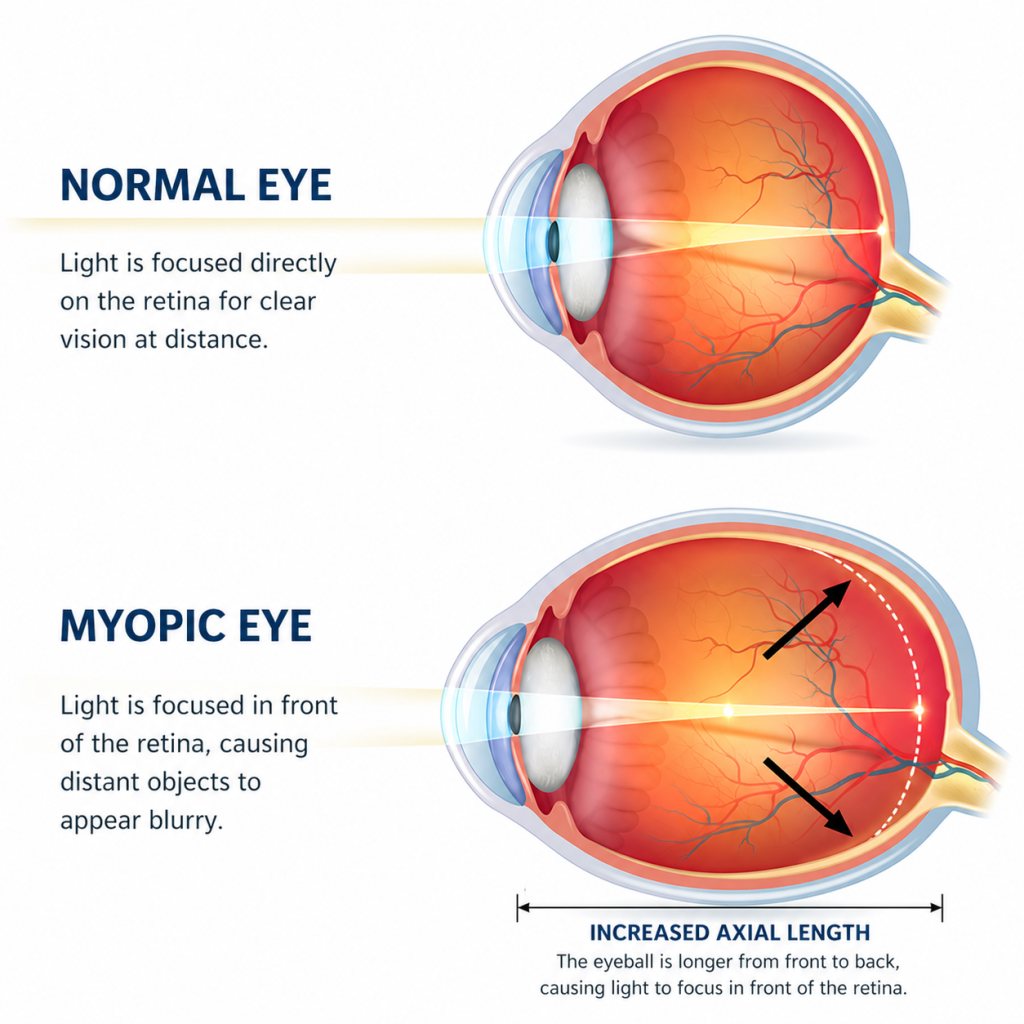
Myopia occurs when the eye grows too long from front to back, causing light to focus in front of the retina rather than directly on it. This results in clear near vision but blurred distance vision. Importantly, myopia is not just an optical issue — it is structural. As the eye elongates, the risk of future complications increases.5
Why Myopia Should Not Be Taken Lightly
Many parents assume that increasing spectacle power is a normal part of growing up. However, higher levels of myopia are associated with a greater risk of serious eye conditions later in life, including:
- Retinal detachment (mild myopia triples the risk of retinal detachment, moderate myopia raises it ninefold, and high myopia increases it more than twentyfold compared to those without myopia)
- Glaucoma (risk increases by ~20% for every -1.00D of myopia)
- Myopic maculopathy (caused by stretching of the retina in highly myopic eyes)
- Early cataracts (often developing a decade earlier than in non-myopic individuals, with higher risk of complications after surgery)
Myopia management is therefore not just about clearer vision — it is about safeguarding lifelong eye health.
The Rising Concern in Children
Children today are developing myopia at younger ages and progressing more rapidly than previous generations. Contributing factors include:
- Increased screen time and near work
- Reduced time spent outdoors
- Intensive academic demands
- Poor posture and lighting during near work
In Singapore, myopia prevalence is amongst the highest in the world, making early awareness, detection and intervention especially crucial.
Signs and Symptoms of Myopia That Parents Should Look Out For
At times, young children may not know how to speak up about their change in vision or difficulties they experience to parents and can lead to a delay in early management. Here are some signs and symptoms parents should be aware of to aid in early detection:
- Squinting
- Moving closer to objects and screens
- Complaints of blurry distance vision
- Complaints of eye strain, discomfort and fatigue
- Complaints of headaches
- Difficulty seeing the whiteboard in school
- Poor performance in sports, activities or hobbies
What Parents Can Do
The good news is that myopia progression can be managed. Taking quick action can significantly reduce the risk of developing high myopia.
1. Schedule Regular Eye Examinations
Children should have routine eye checks, even if they do not complain of vision problems. Myopia can develop gradually and go unnoticed.
2. Encourage More Outdoor Time
Spending at least 2 hours outdoors daily has been shown to reduce the risk of myopia onset in children.
3. Manage Screen and Near Work
Encourage regular breaks using the 20-20-20 rule: every 20 minutes, look at something 20 feet away for at least 20 seconds.
Encourage sitting upright with good lighting when doing near work (e.g. reading and writing)
4. Explore Myopia Control Options
Depending on your child’s needs, evidence-based options include:
- Orthokeratology (Ortho-K) lenses worn overnight
- Myopia control spectacle lenses
- Soft contact lenses designed for myopia management worn during the day
- Low-dose atropine eye drops
Each option works differently, and a personalised approach is key to achieving the best outcome.
Early Action Makes a Lasting Difference
Myopia management is most effective when started early. Waiting until prescriptions become high limits the ability to control progression. By addressing myopia in its early stages, we can reduce long-term risks and support better visual outcomes for your child.
Take the First Step This Myopia Awareness Week
Myopia is manageable — but only if we act promptly.
If your child has not had a recent eye examination, now is the time to schedule one. A comprehensive assessment allows us to detect early changes, discuss suitable management options, and create a plan tailored to your child’s needs.
Book a Myopia Assessment Today
Protect your child’s vision, not just for today — but for the future.
References
- Ha, A., Kim, C. Y., Shim, S. R., et al. (2022). Degree of myopia and glaucoma risk: A dose-response meta-analysis. American Journal of Ophthalmology, 236, 107–119.
- Jeon, S., & Kim, H. S. (2011). Clinical characteristics and outcomes of cataract surgery in highly myopic Koreans. Korean Journal of Ophthalmology, 25(2), 84–89.
- Ripandelli, G., Scassa, C., Parisi, V., et al. (2003). Cataract surgery as a risk factor for retinal detachment in very highly myopic eyes. Ophthalmology, 110(12), 2355–2361.
- Williams, K., & Hammond, C. (2025). High myopia and its risks. Community Eye Health Journal, 32(105), 5–6.
- Singapore National Eye Centre. (2026). Myopia symptoms and risk factors. Retrieved from https://www.snec.com.sg
- Subudhi, P., Zeppieri, M., & Agarwal, P. (2026). Myopia. National Library of Medicine. Retrieved from https://www.ncbi.nlm.nih.gov (ncbi.nlm.nih.gov in Bing)